
loader image

New Music

neptune blood’s “A Quiet Riot Inside” feels like a memory and a real-time scene

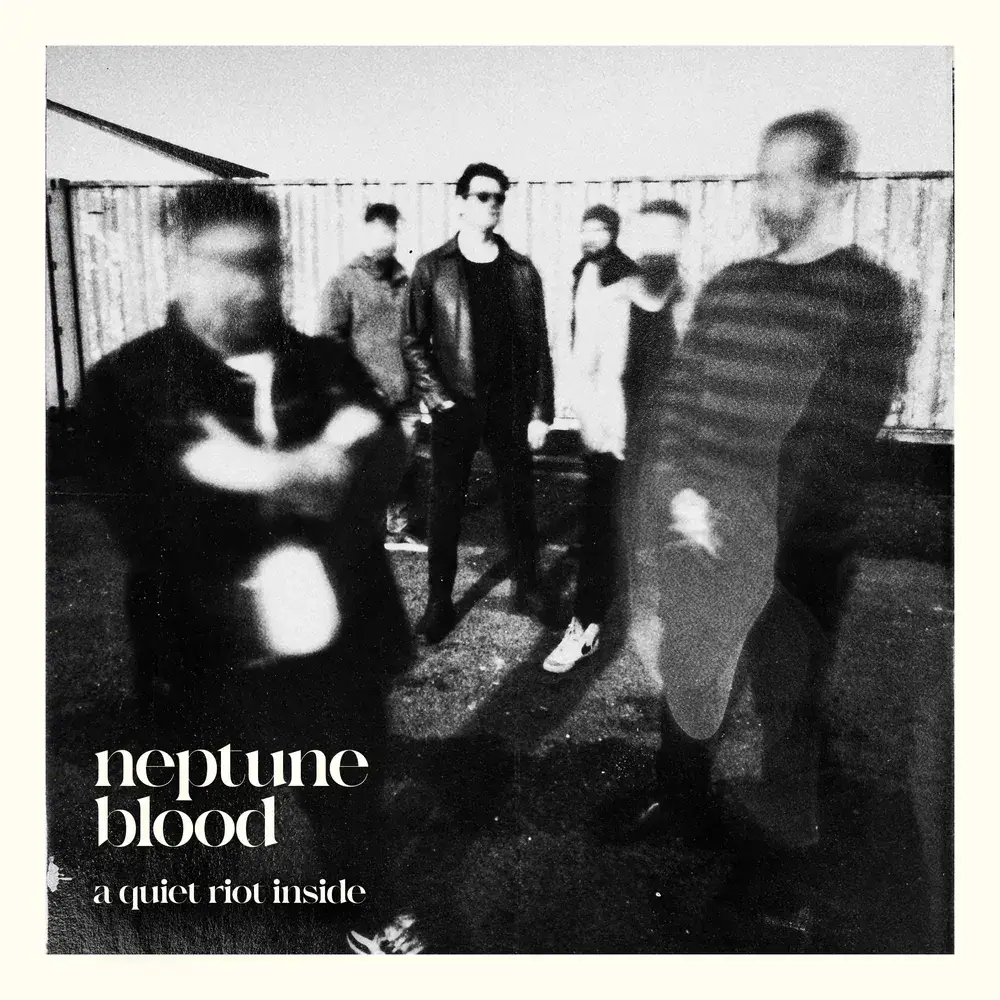
Some songs feel like a throwback, while some strive to sound entirely new. But there are a few cuts that embody both, like neptune blood’s debut EP, “A Quiet Riot Inside.” And it’s the kind of record that feels like a memory and a real-time scene at the same time. neptune blood is a band from Limerick City, Ireland, consisting of Ronan Mitchell, Manolis Pates, Shane Serrano, and Damien Moore. They’re now back on the stage with a four-part EP A Quiet Riot Inside. Recorded with Ben Wanders (Kneecap, The Scratch, Kingfishr) at Wanderland Recording Studio, they throw you into a retro warmth that’s familiar without being predictable. Midnight Showing opens like an indie zine poster slapped on a lamppost near the cinema with edges starting to curl up. Think of a classic film grain being put into sound through soft distortions and boxy, crisp percussions as the airy, reverbed vocals widens the space it created. But there’s this undeniable sound brooding underneath the fuzz, the unsettling tension from the Black Dahlia case. It sits between uncomfortable truth and nostalgia, bruised like a Hollywood dream in an old, dusty newspaper where glamour and tragedy is written on the same page.  Best Laid Plans starts with, “there’s a quiet riot inside,” and it indeed sounds like one. The bass pulses, the riffs scratches, the drum hits are tight, making sure you feel the tension of sitting between restraint and adrenaline from its industrial psychedelic layers. At some point, it flips the whole saying, “if you fail to plan, you plan to fail,” arguing that even the best laid plans can slip through your fingers once life decides to shift and swing. In Calico has that teenage summer-like sound with bright, jangly layers, the kind song that feels like a borrowed youth you’ve never had. This is the kind of nostalgia that goes beyond mere remembering. The peaks and the bittersweet? You’ll feel it in your bones. The hope towards something better and brighter? You’ll also hear it in every note. The band gives you memories and possibilities as they sing “the worst is still the best you’ve ever known.” The EP wraps up with Huge If True, and it definitely rings like closing credits for every song that came before it. The vocals enter with an AM-washed, compressed filter before it transitions to something hazy and cinematic. One moment it’s slow, one moment it pulses, the kind of ending that’s unguarded, honest, and whole.  One thing about A Quiet Riot Inside is how nostalgic and new it feels, each track could live an old tape or a static-filled radio as much as it belongs to bluetooth speakers and Spotify playlists. Aside from their sound, their lyricism goes beyond the surface. They’re not here to do clichés, lazy tropes that most do and they’ll never leave you with something that’s less lived in. Their songwriting will always be personal and full of traces of life.  Overall, neptune blood’s A Quiet Riot Inside nods to early 2000s indie spirit but it doesn’t entirely live in that, giving you something sharper and refined that fits entirely in the present day cut scene. Follow neptune blood Instagram Soundcloud Spotify Promoted Content About the Author

neptune blood’s “A Quiet Riot Inside” feels like a memory and a real-time scene Read More »
“Rebirth” Is Frankly, a Rude Track

There’s a certain joy that arises when a progressive metal band decides to “rebirth” a track, because you never quite know what you’re going to get. Sometimes it’s just a clean mix and a new drum sample. But every so often, a band goes, “What if we rebuilt this entire thing from the astral plane upward?” and then actually does it. Apeiron Bound’s “Astral Reflection – Rebirth” is very obviously the latter, a reconstruction project that feels less like a remix and more like the musical equivalent of tearing down your house because you didn’t like the vibe in the foyer. The track opens with that suspiciously grand, cinematic energy; the kind that lets you know someone spent way too long tweaking orchestral swells at 3 a.m. It’s heavy, it’s layered, it’s absolutely drowning in textures, and it comes across like someone desperately trying to wrestle the entire emotional spectrum into a single metal track. And, impossibly, it works. Everything hits with the confidence of a band that knows exactly how ridiculous progressive metal can get and has decided to sprint toward the edge anyway. The project’s mastermind, Andrew Stout, composes like someone who once looked at the chaos of modern metal and concluded it simply wasn’t complicated enough. There’s a meticulousness to the arrangements as every transition feels engineered, every riff feels placed with tweezers that suggests a man who cannot rest until the music expresses something unusually philosophical. Themes of identity and transformation aren’t just sprinkled in; they’re basically stapled to the track’s forehead. It’s sincere, surprisingly emotional, and absolutely determined to make you think about yourself whether you want to or not. And yet, for all its introspective weight, the track never collapses under its own ambition. Instead, it moves with this weird, graceful intensity, shifting between aggression and atmosphere as if testing how many genres it can hold before the whole structure implodes. Spoiler: it doesn’t implode. It thrives. It has big “I rebuilt my life over a long weekend” energy. This comes on the heels of their reimagined work on Firmament: Redux, which already signaled that the band refuses to leave any idea in peace. Everything must be expanded, deconstructed, philosophically interrogated, and then wrapped in another layer of orchestration. They’re the kind of artists who look at their own songs and go, “No, this could be more.” And then they make it more. What’s most impressive is that this isn’t just complexity for complexity’s sake. Every shift in the song feels like it carries an emotional argument. Every crescendo feels like it’s trying to communicate something cosmically relevant. Even the quieter moments sound like they’re staring directly into your soul, asking why you haven’t completed your personal growth arc yet. “Rebirth” is frankly, a rude track. It comes at you with too much ambition to ignore, too much polish for you to dismiss as experimental noise, and too much emotional clarity for you to call it overwrought. It lands squarely in the realm of “refreshingly sincere,” the kind of music that reminds you progressive metal doesn’t have to choose between being elaborate and being meaningful. And if this is the direction the project is leaning toward; bigger, louder, more cinematic, more narratively loaded, then the future releases are going to be dangerous in the best possible way. In short: this track isn’t just a rebirth. It’s a declaration. And it makes one thing clear: they’re not trying to fit into the progressive metal world. They’re trying to build a new one, one unnecessarily dramatic song at a time. Follow Apeiron Bound Facebook Spotify Bandcamp Instagram Youtube Promoted Content About the Author

“Rebirth” Is Frankly, a Rude Track Read More »

DownTown Mystic’s “Mystic Highway” Is Fully Revved Up Classic Rock N’ Roll With Modern Bite

Isn’t it great when artists add their own flair to classic, timeless sounds? Like they’re not trying so hard to be different, but they also don’t settle for some kind of carbon-copy of the past. DownTown Mystic knows how to do it right with the EP “Mystic Highway”. DownTown Mystic is the alter ego of American Rocker, Robert Allen, joined by seasoned musicians, including drummer extraordinaire Steve Holley (Paul McCartney/Wings/Elton John/Ian Hunter) & Paul Page (Dion/Ian Hunter) on bass, as well as Max Weinberg & Garry Tallent of Bruce Springsteen’s E Street Band. Now, they step on the stage to bring rock n’ roll into the 21st century with a touch of attitude and groove that’s exactly theirs.  The EP welcomes you with History, released in 2011 and remastered by Leon Zervos this year. The guitars from the opening will immediately tell you you’re in for some classic, groovy rock that gives off Friday nights in a roadhouse bar filled with grease, cigarette smoke, and beers. Lyrically, this is the birth of rock and its history in sound, the kind that goes beyond narration and straight up pulls you into the era and dares you to “step into the future and make a little history.” Modern Ways kicks the door open like it has snapped against scams, email pop-ups, and endless calls. Its fast percussion hits and driving guitars are enough to shake off the weight of modern chaos. But the best part is despite the exhaustion, they don’t lose their grin and attitude. They’re grooving over stress, there’s rhythmic punch beneath agitation, all for those who have been restless and overloaded from modern ways of living.  Read The Signs follow with a reflective atmosphere. But despite its laid-back guitars and percussion, there’s a brooding tension underneath, like life and future just suddenly hit them at full speed. The vocals carry a pinch of weariness without dwelling too much in darkness and despair, inviting you to face the truth they’ve been crooning about, “the future is here, read the signs.” Lost and Found rings in the same reflective tone except it’s much more lively in hopes to keep you moving. The EP then ends with a punchy statement from Somebody’s Always Doin’ Something To Somebody. One thing about this Mystic Highway is you’ll get the jagged edges of Buffalo Springfield and Rockpile, that old-school rock without ever losing to nostalgia alone. They honor rock’s golden era with a lived-in honesty, not from the past but from musicians who have experienced life enough to make familiar feel new and fresh. DownTown Mystic gives you rock with depth and meaning, like pieces of life turned into something audibly real. This is rock n’ roll that honors the classic roots with modern day pulse, grit, and attitude.  Follow DownTown Mystic Globe Facebook X-twitter Spotify Soundcloud Youtube Instagram Promoted Content About the Author

DownTown Mystic’s “Mystic Highway” Is Fully Revved Up Classic Rock N’ Roll With Modern Bite Read More »

Throughout Around This Edge Together, The7thGatekeeper Doesn’t Hide the Uneven Edges

There’s a particular magic to DIY albums, by which I mean the kind of magic you get when someone records an entire emotional exorcism inside a room that is, by every reasonable metric, unfit for human occupation. Around This Edge Together is exactly that sort of project: a nine-track odyssey made inside what The7thGatekeeper calls his “home chaos cupboard,” a phrase so perfectly on-brand you want to stitch it onto a flag and fly it above every struggling musician’s apartment. It tells you everything: this is cramped, this is compromised, and this is absolutely the sort of environment where someone would accidentally make their most honest work. The album’s defining characteristic is its refusal to be sanded, smoothed, compressed, or otherwise bullied into radio-friendly presentability. Throughout Around This Edge Together,The7thGatekeeper doesn’t hide the uneven edges; he appears to cherish them. Many artists claim authenticity; this one simply records whatever existential crisis he’s having that day and calls it a mixdown. And that sincerity is the engine driving these songs, not despite the roughness but because of it. “Not to Be Taken” opens the project with a surprisingly sharp punch with grimy, grimy guitars that brush right up against Marilyn Manson’s swampier material. It’s an unexpectedly confident first step, the musical equivalent of someone kicking a door open and saying, “Look, I don’t know if this is going to work either, but we’re doing it.” It’s brisk, emotional, and sets the album’s tone: unvarnished but purposeful. Then comes “5588,” which takes the raw, rattling energy of the opener and asks, “What if Muse’s Drones era had a fever?” It’s jagged, irritated, and clearly intentional. The production may be DIY, but the choices aren’t accidental. The7thGatekeeper understands tension; he knows how to bottle it before throwing it against a wall. “Amulet” gives the record its first breather, though “breather” here means “brief Saliva/Staind-flavored rock fragment that wanders in, makes its point and leaves before you can question it.” It’s a palate cleanser, but one that tells you the album isn’t tied to a single aesthetic. It’s allowed to be both small and dramatic. Then we get to “The Hoard”; the album’s most fully realized barnburner and the place where the Muse influence stops winking coyly and starts openly screaming from the mezzanine. The song rises and collapses in waves, like it’s trying to evolve into something bigger but keeps tripping over its own ambition. It’s exhilarating to witness the attempt, though, because the intent is so honest. “Baryon II,” meanwhile, arrives sludgy, catchy, and weirdly adjacent to early-2000s nu metal in a way that feels deliberate but not derivative. And then immediately after, “Wrapped” swings in the opposite direction, brushing up against Nine Inch Nails ambience despite being built out of the same DIY toolset as everything before it. These two tracks form a miniature thesis: experimentation isn’t a side quest for The7thGatekeeper, it’s the point. “Inamorata” is where the record suddenly remembers that acoustic instruments exist. The Jason Isbell influence finally steps out of the wings and clears its throat. It’s a quiet gut punch; simple, delicate, and a necessary exhale after so much density. “The Garden” stitches that same country-folk tenderness into the more theatrical, Muse-tinged palette of earlier tracks. It’s transitional music; the kind that sounds like a long walk back to yourself, which is exactly where the album needs to be heading before its finale. “(Fear) Wet State,” is a five-minute meditation on holding your own skull together with sheer force of will. It’s dense, measured, atmospheric, and intentionally exhausting in the way a good album closer should be. It doesn’t wrap things up; it leaves you suspended, gnawing on the project’s emotional residue. And here’s the thing: the entire album sounds like a guy learning in real time how to be a producer while also trying to deal with his feelings, global collapse, personal history, and artistic ambition simultaneously. That could easily be a disaster, but instead, it becomes the album’s identity. Every imperfect mix choice, every rough vocal layer, every moment where the song feels one revision away from snapping in half… it all makes the emotional core more tangible. Around This Edge Together isn’t polished. It isn’t clean. It isn’t even particularly stable. But it is honest; unflinchingly, endearingly honest and that sincerity carries more weight than technical perfection ever could. Follow The7thGatekeeper Globe Facebook X-twitter Spotify Soundcloud Youtube Instagram Tiktok Promoted Content About the Author

Throughout Around This Edge Together, The7thGatekeeper Doesn’t Hide the Uneven Edges Read More »

deadwater’s Revelry in Reverie Is the Rare Basement Grunge Record That Isn’t Defined by Its Limitations

There’s something strangely beautiful about an album made entirely in a basement. Not in the romanticized, Hollywood-montage sense, but in the real sense: a probably-too-humid, maybe-questionably-wired below-ground bunker where a man with a guitar and a laptop decided that normalcy was overrated. That man is deadwater, and the result of his subterranean stubbornness is Revelry in Reverie, a record that sounds exactly like what happens when someone picks up a guitar during COVID, realizes life is too short not to yell into a microphone, and then, somehow, becomes legitimately good at it. This isn’t the triumphant rise of a long-trained virtuoso; it’s the far more interesting story of someone who discovered art by falling face-first into it… and then refused to get back up. What makes the album remarkable isn’t just that it was recorded in a basement; it’s that you can hear the basement in it; in the warmth, the grit, the occasional sonic bruise that proves a human made this. The DIY ethos isn’t a marketing angle; it’s the bloodstream of the album. Every creak, buzz, fuzzed-out edge, and imperfect layer is a deliberate rejection of polish in favor of honesty. Imagine grunge, already a genre built on imperfections, then imagine someone asking, “What if we made it even rougher?” Revelry in Reverie answers this question with the confidence of someone wielding duct tape like it’s a Grammy-winning production technique… and discovering it works better than it has any right to. Lyrically, the album is equally raw as a chronicle of sobriety, introspection, and the weirdly claustrophobic sensation of trying to find joy again after reformatting your entire life. Sobriety here isn’t portrayed as enlightened clarity; it’s an ongoing quest where the villain is your past self and the final boss fight happens in the silence of Saturday night when you’re not sure what to do with your hands. The “reverie” is the endless thinking. The “revelry” is discovering that thinking doesn’t kill you. Altogether, it forms an unexpectedly potent emotional core; the kind of thematic focus that’s difficult to fake and impossible to engineer through studio gloss. The album opens with “Neon Black,” a tight, concentrated spark of electricity that punches you in the mouth and leaves before you’ve realized you’re bleeding. It’s a mission statement disguised as a track. “Dying Breed” follows, kicking in with a faint country-lilt in the vocals layered over grunge instrumentation; an unlikely stylistic marriage that somehow works. Then “Spit It Out” arrives, the shortest of the early tracks, all directness and velocity, like deadwater is saying: Get in loser, we’re doing catharsis. “Siren Sound,” the first major tonal shift, brings four minutes of drifting ambience and echoing space, like being sung to by the version of yourself you’re trying not to be anymore. It’s haunting, atmospheric, and in an unexpectedly sophisticated way, cinematic. It’s also the track where the album first reveals the depth of its compositional instincts. This isn’t just a guy playing riffs in a basement; it’s someone quietly showing they know how to build a world out of sound. “She Don’t Care” arrives next with a vocal delivery reminiscent of Hobo Johnson if he traded spoken-word theatrics for grunge melancholia. Then there’s “Mexico (Hey Now),” a slow-burner soaked in emo-rock crescendos, the kind that lift gradually, then crash like someone finally exhaling after holding their breath for ten years. Both tracks reinforce the album’s commitment to emotional realism; messy, uneven, and honest enough to sting. Then comes the heavy artillery. “Voices,” the standout of the record, erupts with grungy riffs, primal yells, and a sense of desperation sharpened into something powerful. It’s the album’s emotional thesis statement; not polished, not controlled, but intensely real. It feels like someone excavating their inner demons with a garden shovel. From here, the album leans even harder into introspection. “Tuesday Evening” explores the monotony of a sober life, ironically delivered through subtly psychedelic tones. “The Hell Song” nails the spiraling internal monologue that arrives uninvited in public spaces. “Darkest Nights” follows with the inevitable existential dread reserved for the moments you turn out the lights and accidentally think too hard. “Comin’ Back,” the closer, is deceptively hopeful; not in a saccharine way, but in a “look, I’m not dead, and progress counts even when it’s boring” way. It’s cautiously triumphant, grounded, and mature. There’s no heroic swelling orchestra, no “I’ve conquered my demons” finale. It’s a shrug, a smile, and a quiet acknowledgment that healing isn’t glamorous. It’s something you do before folding laundry. deadwater didn’t set out to make a genre masterpiece. He set out to make something true. The fact that he stumbled into something powerful along the way feels like the ultimate DIY victory. This is the rare basement grunge record that isn’t defined by its limitations, but by the clarity of its vision. Revelry in Reverie is grunge for the emotionally exhausted, punk for the perpetually self-analyzing, and indie for anyone who wants music that sounds like it was recorded five minutes after a breakthrough and ten minutes before a meltdown and it works spectacularly. Follow deadwater Instagram Spotify Promoted Content About the Author

deadwater’s Revelry in Reverie Is the Rare Basement Grunge Record That Isn’t Defined by Its Limitations Read More »

Joseph Kuhl’s “The Witness” Refuses To Let Anyone Look Away

There are musicians that step on the stage to perform, but there are a few who do music like a hand-written placard: red letters, bent cardboard, rough edges. Joseph Kuhl’s “The Witness” is one of the few, the one for crowds, marches, meant to be shouted back in the streets. Joseph Kuhl’s musical roots trace back to Athens, Georgia, in the late 1970s. Channeling the spirit of blues legends, Bob Dylan, and REM, he releases The Witness, a sonic document on the tragedy of war and colonization on Gaza.  The Witness only gives you a guitar and voice for the opening, like it’s been mentally preparing you for everything that will follow. Kuhl drops the line, “look in your heart,” with his raspy, whiskey-soaked-like vocals like it was made for truth and truth only. The track then gradually unveils its sharp drum hits and distorted guitars that urges you to sit down, look him in the eye, and let it sink to you.  It takes a lot of courage to write with integrity, to relay an unfiltered, messy truth that the world isn’t ready to hear. You can also feel his profound connection to the Middle East and his personal experiences, amplifying the track’s grounded and raw sound. Kuhl doesn’t want you to be entertained, he wants you to move, speak, and open your eyes. He’s not just singing about the Palestinian people; he’s shedding light on realities that are shadowed by disconnect and apathy. Joseph Kuhl’s “The Witness” is a rock statement, stripped down of fancy metaphors and polished layers. It’s a record that exposes, opens eyes, and demands action for those who have seen so much.  Follow Joseph Kuhl Facebook Spotify Soundcloud Youtube Promoted Content About the Author

Joseph Kuhl’s “The Witness” Refuses To Let Anyone Look Away Read More »

Michellar and Rad Datsun’s “Game of Love” Is a Track Built With Burning Passion

Music knows no bounds. That is a clear and true testament to Michellar’s newest track, ‘Game of Love’ featuring Rad Datsun. Regardless of distance, these artists were able to create a song that would capture their passion in R&B and Soul. ‘Game of Love’ started with this low-filtered drum beat, followed by that funky bass line that works hand in hand with that R&B/soul vocal phrasing. Everything in this first part feels and sounds symmetric, even the keyboard lick. Everything gels perfectly like peanut butter and jam.  The vocal harmony is a match made in heaven. The voicing is as natural as it gets. What I like about this track is that the chorus hook is short. It can catch any listener’s attention because it follows what we call the K.I.S.S formula. Keep It Short and Simple. The chorus is just 5 words, making it easy to remember.  The guitar lick on the last part of the track is a great addition to the overall texture of the track because of its simplicity, repetitive, but catchy hook.  ‘Game of Love’ is a track built with burning passion for the arts. Regardless of Michellar and Rad Datsun’s geographical distance, they were able to create a track that screams simplicity, beating masterful technicality.  Michelle Bond · Game of Love featuring Rad Datsun Follow Michellar Globe Soundcloud Bandcamp Instagram Facebook Promoted Content About the Author

Michellar and Rad Datsun’s “Game of Love” Is a Track Built With Burning Passion Read More »

Giuseppe Cucé’s “21 grammi” Isn’t Just A Concept, It’s The Gravity Of Human Experience

It’s a bit of a downplay to call Giuseppe Cucé’s “21 grammi” an album. You know when an artist is serious about their work, and there are not enough words to unearth its depth and meaning? That’s exactly it. It’s the kind that doesn’t just stick but leaves you smirking, intrigued, changed, or even challenged. Sicilian singer-songwriter Giuseppe Cucè is back with another hit curation, 21 grammi. Recorded and mixed at TRP Studios in Catania, the album offers soul, Italian cantautorato, orchestral textures and atmospheric arrangements. With the artistic production of Riccardo Samperi and a team of exceptional musicians, Cucè leaves you with a record that feels like an accessible tapestry of contrasts and unfiltered truth of being human. È tutto così vero opens the album with a sprightly harmony from the flute and trumpet, the sound that will immediately light up the room and bring movement to everyone. The light percussion hits and brassy accents color the track like a dance hall with people skin to skin, as an understated sensual depth clings into air. It’s a Latin-pop fused track made for crowded rooms and dance nights.  Whatever the opening track established is quickly torn down as Ventuno slips in. And right from the first note, you’ll understand why this is described as the emotional core of the record. You’re not dancing in the hall anymore, you’re finding meaning in the chaos, you’re pondering about love, flesh, beliefs, and the pulse of rebirth. What you’ll love from this track is its depth, its weight, its expansive and reflective edge that hits you from the get-go.  Dimmi cosa vuoi exists in the same atmosphere as the lead single. Cucé’s voice is one with the soft keys and its layers. While others try to stand out with volume, this one thrives in restraint, the kind of track that hits deeper the more it opens up and shares more than the surface. Tutto quello che vuoi rings in a lighter tone yet brings honesty and truth that is deeper than what you’ll expect from its bright layers. This track thrives in contrasts and imagery, a punchline and unfiltered reflection made accessible.  The album ends with Di estate non si muore on a groovy, lively arrangement yet carries a name in one summer one does not die. It’s introspective and surreal, a closing act that doesn’t just conclude the album but leaving you wanting more.  All nine tracks in this album hold specific depth and meaning to the point where it can stand on its own. But having it in one record is something else entirely. Cucé curated it in a way that will leave you with a whole new experience, the kind you won’t get from some formulaic, overly saturated sounds on your FYP. Cucé’s lyricism is unmatched in this album because he will never leave you empty-handed. Whether you’re moving your body, you’re unsettled, or contemplative, he makes sure you carry something from it — a memory you recalled, an emotion you want to feel, or even a borrowed experience from him.  Aside from his artistic identity, it’s also notable that the touch of other seasoned, talented artists gave dimension and nuance to the whole album, harmonizing with Cucé’s vision and overall intention.  21 grammi isn’t just a concept, it’s the gravity of human experience that cannot be measured through numbers alone. There’s loss, love, memory, identity and the entirety of fleeting, small fragments of life that often leaves the deepest marks. Whether you’re pondering about the weight of this life, or simply lost in a pool of today’s music, Giuseppe Cucé’s “21 grammi” will definitely be an unforgettable odyssey.  Follow Giuseppe Cucé Instagram Spotify Promoted Content About the Author

Giuseppe Cucé’s “21 grammi” Isn’t Just A Concept, It’s The Gravity Of Human Experience Read More »

Red Skies Dawning’s “From Ashes” Burns With Lived-In Rage And Resilience

Red Skies Dawning isn’t afraid to drag their music into the dirt. While others are too comfortable in polish and TikTok-worthy sounds, the band muddies the edges until the gloss and trend is finally gone. With their latest EP “From Ashes”, they open a portal to a world built from survival and wreckage. From Ashes was co-produced and mixed by Chris Dawson (SAUL, Any Given Sin) and Jimmie Beattie who also mastered the record. This 6-part EP introduces Red Skies Dawning’s raw and cinematic sound, the kind that has volume but never shallow or empty.  The EP opens with Where You Been, pulling you over with a scream and guitars that feel like rust grinding over steel. But underneath its roughness, there’s vulnerability as the vocals sing, “where you been,” repeatedly. What you’ll get is yearning from falling too deep, the kind that hits closer to the chest.  Obvious as the lead single makes so much sense, carrying the project’s core pulse and thematic spine. Right from the start, the siren-like sound followed by rough guitars immediately tells you this isn’t going to be a smooth ride. This track circles around the disorienting feeling of losing yourself in the fleeting nature of life, until a spark of clarity hits and reveals an open door, the kind you’d only get after getting lost in the chaos. Their debut single Shipwrecked welcomes you with fast, punchy drum hits and bold guitar riffs. The vocals ride above the percussion, having the same amount of grit and aggression all throughout as they sing, “all I see is dark skies covering my eyes and I am doing it blind.” Think of tension and release colliding in the same space, falling apart yet still anticipating what’s next.  They also covered the classic Don’t You (Forget About Me) by Simple Minds. If the original radiates that bright ’80s confidence, Red Skies Dawning wants you to experience something different. The vocals are edgy, the guitars are sharp, and the drums are thunderous. They shout, swapping polish for catharsis, letting the jagged edges shine with its rawness.  When Red Skies Dawning said it’s everything they’ve torn down and rebuilt piece by piece, they’re not lying. Think of a sound that’s big and loud to shake the ground but still fragile and human. They’ve got grit, rage, and tenacity but it doesn’t end there. The screams and riffs tell you they’ve lived it. From chaos and pain to rising and survival, they made sure it’s planted deep in each track, surpassing mere storytelling.  So if you’re into bands that does more than performing rage and resilience, you’re in the right place with Red Skies Dawning’s “From Ashes”. Follow Red Skies Dawning Spotify Youtube Globe Facebook Instagram Promoted Content About the Author

Red Skies Dawning’s “From Ashes” Burns With Lived-In Rage And Resilience Read More »

With Dancing My Way to Happiness, AmorA Essentially Said “Fine. I’ll Make My Own Universe. With Neon. And Synths.”

There’s something deeply funny and deeply satisfying about watching a lifelong behind-the-scenes wizard finally step out from behind the curtain. AmorA spent years building entire universes for other people: scoring films, shaping sound for video art, and even helping win a Grammy for Star Wars Jedi: Survivor. She has been, musically speaking, the person responsible for the part of the movie everyone cries at. And now, with Dancing My Way to Happiness, AmorA essentially said “Fine. I’ll make my own universe. With neon. And synths.” The result is an electro-pop debut that feels equal parts personal journal, 80s fever dream, and end-credits sequence for a movie that doesn’t exist yet, but absolutely should. The most immediately striking thing about the album is how confidently cinematic it is. Many pop artists describe their work as “cinematic” and AmorA’s actually is, because she treats each song like its own short film. Synth pads don’t just shimmer; they establish location. Voiced chords don’t just move. Rather, they foreshadow. Percussion isn’t just rhythm. If anything, it’s narrative urgency. If the average pop album is a diary, Dancing My Way to Happiness is a storyboard. Every track clearly understands what it’s supposed to feel like first, and then arranges itself accordingly. It’s the kind of intentionality that comes from someone who has spent years building emotional architecture frame by frame. The album kicks off with “Alone in the Dark,” a relative-slow-burn opener that sounds like it wandered out of Aurora’s Cure For Me sessions before deciding to brood for a while. It’s the thesis statement of the whole project: vulnerability delivered through glossy production, anguish contained in clean synth geometry. AmorA’s voice moves between fragility and determination, like someone singing through the last echoes of a panic attack while also telling you, very politely, to get it together. It’s a quiet but powerful entrance; one that immediately signals this won’t be a debut album built on “Look what I can do!” moments. It’s built on clarity, on feeling, on letting mood drive structure. Then, in comes “Fire,” which feels like a DJ Snake track if DJ Snake went on a silent meditation retreat and came back enlightened but still a little unhinged. There’s a heat to it and yes, fine, the title is unsubtle, but the flame here is more internal than club-oriented. The synths glow more than they blast; the beat simmers instead of detonating. It’s the first moment where you can hear AmorA’s sound-design brain fully at play: tiny clicks, pulses, and atmospheres arranged with the kind of obsessive detail usually reserved for AAA games and movies about robots. And yet, she never lets the technical precision overshadow the emotional core. This is a track about desire and disorientation, and she makes both feel spatial; heat rising, air thinning, gravity tilting upward. By the time we hit “Keep Me Alive,” we’re in the emotional center of the record: the raw “please don’t let go yet” heart of the story. If the first two tracks are atmosphere and ignition, this one is the confession. It could absolutely live on Holly Humberstone’s debut; lush, aching, and melodically poised between breakdown and breakthrough. AmorA leans into breath, into rising synth arcs that swell exactly when the lyrics tighten, as if the production itself is trying to steady her. It’s pop, yes, but the way the song structures emotional escalation almost frame by frame as it reveals her scoring roots. She’s not just writing a song; she’s animating an internal collapse in slow motion. The mid-album shift into “What I’ve Known” serves as the quiet reflection scene in the movie. The beat feels like the kind of tropical-ambient fusion Kygo might make if forced to score an animated film about self-acceptance at sea. It’s soft, deceptively simple, and full of tiny sonic details that reward repeat listens. This is AmorA allowing stillness, allowing breath, allowing a moment of shoreline before the emotional storm resumes. It’s less flashy than the rest, but intentionally so; it’s the pause the story needs. “I Can’t Pretend Anymore” is where the album regains urgency. The track sounds like pre-debut Billie Eilish production filtered through the vocal versatility of Hit Me Hard and Soft–era Billie; a fascinating hybrid of minimalist beats and maximal emotional precision. AmorA’s voice slices cleanly through the electronic stutter, delivering the album’s most direct moment of emotional confrontation. If earlier tracks processed heartbreak, this one refuses to excuse it. It’s not a plea; it’s a declaration. And the arrangement mirrors it with sharp, clipped rhythms and a sense of building pressure that never fully resolves. It’s messy, deliberate, and quietly devastating. Finally, the title track, “Dancing My Way to Happiness,” arrives like a curtain call. It sounds and I mean this in the highest possible compliment, like the end-credits theme for a Disney film about reclaiming joy after emotional apocalypse. It’s luminous, wide-screen, and achingly sincere. Not triumphant in the cheesy sense, but triumphant in the exhausted, earned, human sense. AmorA doesn’t present happiness as a miracle; she presents it as an action; an act of movement, a choice to reach toward the light even when it flickers. It’s a stunning closer that ties together all the album’s themes: vulnerability, self-repair, and the messy process of choosing joy without pretending pain didn’t exist. As debuts go, Dancing My Way to Happiness is astonishingly self-assured. Every track feels considered, cinematic, and emotionally present. AmorA manages a rare feat: blending the precision of a film composer with the rawness of a pop diarist. The result is an album that doesn’t just sound good; it feels intentional, like every synth burst and whispered harmony is another brushstroke in a much larger picture.  Follow AmorA Facebook Youtube Instagram Spotify Promoted Content About the Author

With Dancing My Way to Happiness, AmorA Essentially Said “Fine. I’ll Make My Own Universe. With Neon. And Synths.” Read More »