
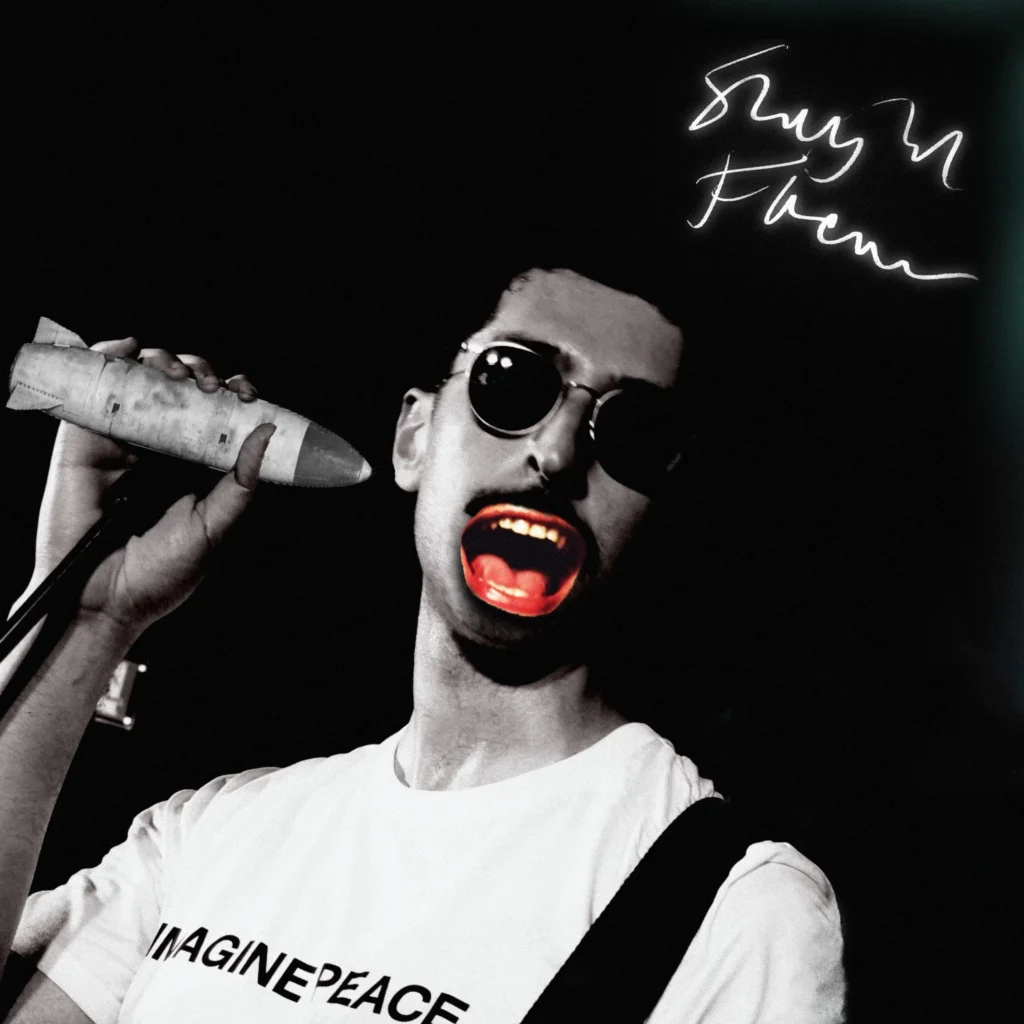
There is something strange about dancing to music about war. It is not that the two should not go together, rather that so much of what you are dancing to often couldn’t care less about the lyrics as long as that bass is pumping. Coupling a furious rhythm with a groove trying to get out of the room and your body won’t stop to ask you what you are supposed to be doing.
Sheykh Forever understands this. On Fire in the Master’s House, Iraqi-born, London-based musician Mostafa Al, a long-standing alternative musician, pairs disco, funk, heavy rock and distorted electronic pop to sing about war, exile, propaganda and survivor’s guilt. It is an album that draws you to dance despite the fact there isn’t anything more than the most desperate of songs about the horrors of war. The trick, as it ever was.

Written, produced, mixed and mastered at home over four years, 14-track LP has the feel of a dance floor caught in a very strange dreamscape. As much as the pop melodies are accessible, the sensation there is something lurking just out of sight to jump out and catch you unawares. The mixture of vintage equipment and digital production gives the music a slightly mangled feel, like a road trip into the future only to find that it is having a bad day.
Displacement and home echo through the album, opening with ‘I’m Your History’. This is not a collection of hollow political sloganeering wrapped in a couple of “important” buzzwords. The songs dissect what it means for history to make your life the way it does, no matter how little control you have over it, whether home is somewhere you can return too or carry with you even when the world has other plans for you.
‘Ghosts!’ and ‘Same Disease’ carry this a step further into how violence and trauma echo long after everything else has moved on. History is not a thing of the past, it continues to cause collateral damage, passing it down through the generations and into people, families and communities. There is a feeling that runs through the album that history is not a completed piece but a collection of clutter in a room that people continue to attempt to organise.
What is great about Sheykh Forever is that he does not follow the “musical funeral procession” with all of this, which would be the easy way out. But, on Fire in the Master’s House he finds something more interesting in the juxtaposition of darker themes with irresistibly engaging grooves.
‘Sleeping Dogs’ and ‘Run for Cover’ are prime examples. Their driving rhythms refuse to stop, even as the lyrics imply that whatever you are fleeing from isn’t all that different to what you are running towards. Very, very groovy, sure, but there is a sense of wrongness lurking just underneath the surface. It can make you want to dance, but whether you should feel good about it is a whole other matter.
That is what makes the album’s combination of disco, funk, rock and electronic music so effective. Dance music is not always about losing yourself. Sometimes it is about fighting. Sometimes it is about holding on. And sometimes you have to keep moving forward because stopping means facing all the things that you have spent your life running away from. Sheykh Forever leaves the door open for all of that without preaching to you.
The production only adds to the feeling of uncertainty. Some tracks wander from sparkling pop to more aggressively electronic noise, with odd textures occasionally creeping in to distract from the danceable grooves. The album never settles into the expected formula of heavy lyrics over happy music, instead holding on to keep you hooked while refusing to make you entirely comfortable.
Comparisons to Nicolas Jaar, Blood Orange and the Bar-Kays go some way towards describing the album’s mix of electronics, pop and funk. But Sheykh Forever’s finest hour comes when the influence of these artists ceases to matter and his own voice takes precedence. It is not just a collection of inspiration, but rather a utilisation of these influences to create a universe of his own.
That air of looseness can sometimes make the album feel slightly disjointed, but it works for the subject matter. Grief, anger, guilt and fatigue sit with the desire to survive. Not everything has to make some great statement when the music can evoke pain far better than any words ever could.
In the end, Fire in the Master’s House does not allow war and displacement to be reduced to a distant concern wrapped up nicely in a song. It is haunted by history, memories and the inherited trauma and guilt that lingers on. It is not an easy way out and the album is not trying to con you otherwise.
Sheykh Forever has created an album that burrows into you before you have had time to get to grips with it. The grooves draw you in, but the darker edges remind you of the layers beneath. Funky, unsettling and at times disorientating, its energy is not rooted in a desire to escape but one to keep on going.
The world is on fire. The music’s still playing. What you do with the contradiction is up to you.
Follow Sheykh Forever
About the Author

A tenured media critic known working as a ghost writer, freelance critic for various publications around the world, the former lead writer of review blogspace Atop The Treehouse and content creator for Manila Bulletin.