

It’s pretty revealing when an artist chooses to reinstate vocals after an album devoid of them. I suppose instrumental music can say a lot, by default. It can move you to feelings you had no idea you had access to; it can persuade you that long stretches of staring out the window are an entirely justifiable way to kill 20 minutes. But songwriting is a different kind of vulnerability: there’s a person, a story, words, behind that sound.
this side of the door: The Italian-born, songwriter and producer Gianfranco Pescetti, 2024’s instrumental electronic album Daystar Nocturnal, is back to songwriting and singing for his third album, due November 6, 2026. It’s 14 songs about memory, relationship, love, loss and transition, blending lush electronic atmospherics with live instrumentation and old school singer-songwriter warmth.
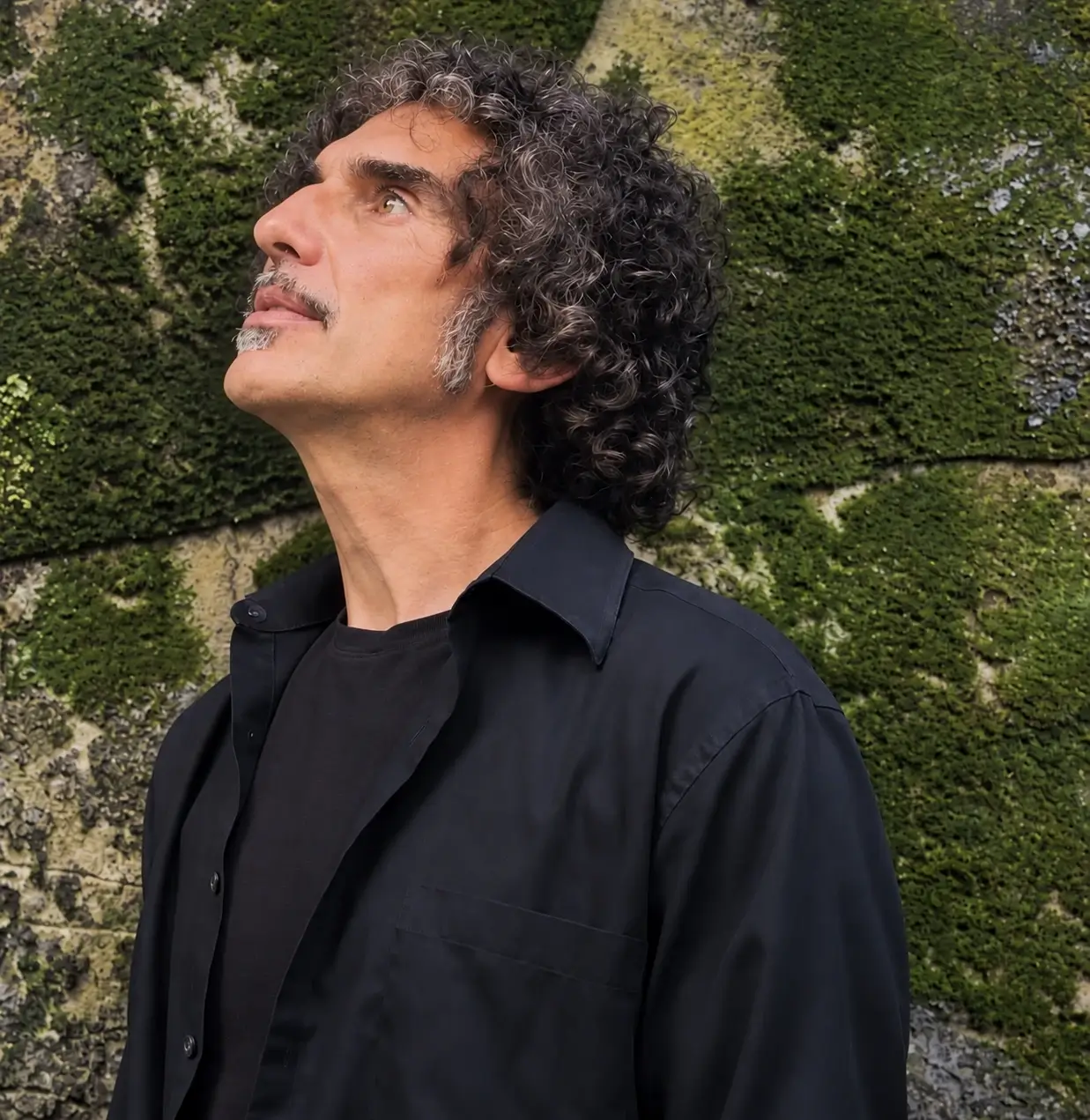
It’s not a radical rebranding, either. Pescetti isn’t junking his synths and turning up with an acoustic guitar to proclaim that he’s found some emotions. Rather, he takes the technology and ambient palette of Daystar Nocturnal and infuses it with a more intimate quality using singing and songwriting, a convincing progression which proves to be one of the record’s most enjoyable aspects.
The first song, “Nightbloom” sets the tone, with a dose of gloom reminiscent of The Cure and M83. It employs minimalistic, heartbeat-like kick drums to give it a sense of life without turning it into a club track. “Flicker” keeps the dark new-wave vibe going, while “Colors with No Name” adds a heavy dose of retro on the synth-bass, which would sound right at home on a Stranger Things episode.
These recognizable noises aren’t just nostalgia bait. Pescetti balances them against modern electronic production, making for an album that’s retro without being backward-looking. The arrangements often hold back, but enough quirks jump out to prevent this record from sounding like a bunch of interchangeable synth workouts.
The emotional focal point is “Heidi”, a tribute to the late cellist, architect and visual artist Heidi Vincent, who inspired Pescetti to see himself as a songwriter. He doesn’t write the song as a lament, but as a “thank you” for somebody who saw his greatness before he saw it himself.
It’s a hugely ambitious concept, and one that we don’t always think about when we listen to the final results, be it the album, the show, the painting. Pescetti leverages that impact as the core of his song, and he’s even playing a 1977 Fender Precision Bass that Vincent passed on to him as a gift, transforming the bass into a memorial of their friendship. It’s a subtle but meaningful touch.
A Different Joy drifts into even more ambient realms, with its sparse textures making good use of negative space. Like everything but the girl, much of the emotion is carried by the simple, subtle production. “Sugar Cut” is nearly operatic in the grandeur of its booming kick drums, strings and tight multi-vocal harmonies, despite being a fairly subtle piece of music. It’s a paradoxical thing, a piece of music that feels like it’s trying not to show off, while building a rich and fantastical musical set.
Meanwhile, the grim “Her Name Was Petal Storm” mixes guitar solos with trap beats and feels like a dark, contemporary new wave throwback. And it’s one of the most compelling track pairings on the album, showing Pescetti’s aptitude for mixing different modes without the music feeling like an experiment.
“Vanishing Point” shifts gears again, singing with a certain gothic romance and drone-y quality as it rolls along toward the end, reminiscent of The Smiths. The final song, “Who Imagines Who,” shifts away from synths again and turns into more of a CHVRCHES song, but it makes a great way to wrap up a record that was saturated in nostalgia-inducing electronic sounds.
The album’s primary weakness, oddly enough, is that the most pervasive aspect of it is Pescetti’s fascination with atmosphere that can cause some of the tracks to get lost in the overall sensory experience. Those expecting immediate interest or significant transitions in energy might find a few sections of the album a little underpowered. On the flip side, however, this sense of cohesion creates an identity for this side of the door that feels made to be appreciated rather than exploited.
The electronic production works in tandem with the songwriting, rather than against it, providing a home for these songs. The live instrumentation provides some comforting warmth, the vocals add some up-front immediacy to the music. Pescetti’s hit a middle ground between the richly textured Daystar Nocturnal and the more emotional approach of a songwriter album.
“this side of the door” is ultimately a soulful and considerate return to the vocal focus. It may sometimes sacrifice rhythm for atmosphere, but this is by far the strongest example of Pescetti translating personal experiences into an inviting, rather than inaccessible, musical experience.
Pescetti has not turned his back on the electronic worlds he has labored to create for so many years. He’s just heard the human voice, and frankly, that alone has been enough to usher him to the door.
Follow Gianfranco Pescetti
About the Author

A tenured media critic known working as a ghost writer, freelance critic for various publications around the world, the former lead writer of review blogspace Atop The Treehouse and content creator for Manila Bulletin.