
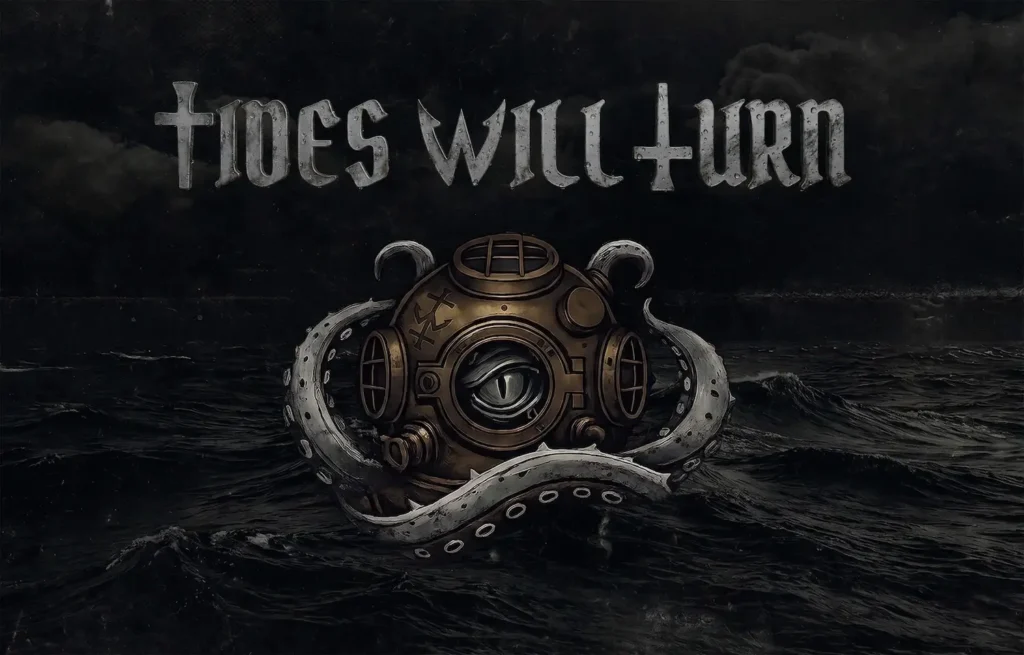
Every “Is Rock Dead?” article since 2004 has been wrong about people still making plenty of rock music, and Tides Will Turn‘s debut album is a wonderful example of this fact. But what is truly surprisingly rare, even now, is an album from an actual band that seems genuinely invested in the prospect of making an album instead of simply stringing together several potential playlist fillers. Tides Will Turn by the identically named British Columbia band does just that immediately from the start.
“Lifetime Ago Go,” the opening number, wastes absolutely no time. It hits with the sort of guitars that remind you that sometimes the simple ability of a guitar to sound like a guitar is all it needs, which is an idea so out of date for now that it seems revolutionary in this record’s context. But then much of this record just seems so completely unconcerned with whatever passing trends the streaming service era holds.

This album relies on a different background for this very reason, leaning on the lineage of artists such as The Clash, Creedence Clearwater Revival, Johnny Cash, and The Cramps without directly imitating them, or using their records as inspiration to craft what feels like the musical blueprint for any storytelling record, a record more concerned with atmosphere and character than sonic stunts. According to the band, Tides Will Turn is meant to be an cohesive listening experience, a feat that feels increasingly rare.
Listen to early highlights such as “American Sole” or “Life and Death.” The first is full of crunchy guitars and driven drums before opening up with intricate leads while the second embraces a kind of smoky, worn-in, almost forgotten rock-and-roll attitude that feels as if it’s aged in some dusty, oak-aged cask. In both cases, what the album shows you, quite brilliantly, is that this is a record written with confidence, not swagger. Swagger needs to be admired, whereas confidence just assumes it has your respect.
Instead, this record quickly shifts from a collection of individual songs to an entire immersion into the band’s world. “Port Home” introduces a more optimistic, up-tempo feeling, while “Never Gonna Win” lays down a slinky groove that calls back to a time when indie rock didn’t constantly feel like it was trying to deliver an intelligent witty jab every five seconds. This is a surprisingly liberating listen, especially given that, today, it seems as though, through the eyes of critics at least, authenticity and simplicity in music are increasingly being mocked in favor of clever, detached irony and references.
In the last few years, our digital culture has successfully turned everything into a game of communication through the intermediary of detachment; every song has to be a joke, a reference to a joke, or the reaction to a joke. Now, you have this album out here singing about who you are, the consequences of your actions, survival, what happens when you become an adult and don’t get to ask for a guest room, among other things. This is when this record truly becomes interesting;
Because behind the Americana, the punk attitude, and the influences, there’s a theme running throughout: the continuation of artistic creation in a world where life has become increasingly complex. These aren’t tracks for ambitious rock stars hoping to make it big-they’re tunes that seem to have been written by people who have already seen and experienced enough of life to realize that human existence is far more peculiar than celebrity can ever be.
This sentiment provides emotional heft to “Hearts on Fire,” “Home Wrecker,” and “Screaming Hill.” “Hearts on Fire” starts small, slowly building up from stripped-down guitar until it’s one of the most energetic tracks, “Home Wrecker” is appropriately messy, and “Screaming Hill” offers some of the album’s most impressive atmosphere. This last track combines distorted guitars with a steady beat to really give Matt Chevy’s voice a chance to shine. Every bit of it sounds truly alive.
It all even works with the final track, a cover of “Dancing in the Dark.” Every cover is tricky because the audience knows the original, but Tides Will Turn makes it their own and turns a song into a reflection of its themes.
Tides Will Turn is great because it embraces something many contemporary records have either rejected or simply failed to recognize; authenticity isn’t a marketing strategy. Rather, it’s a symptom of having something sincere to share.Tides Will Turn doesn’t strive to reinvent the concept of rock; it doesn’t even strive to save it. All it believes in is solid songcraft, the authenticity of performers and their experiences. After spending an hour listening to these tracks, it is rather difficult to disagree.
Follow Tides Will Turn
About the Author

A tenured media critic known working as a ghost writer, freelance critic for various publications around the world, the former lead writer of review blogspace Atop The Treehouse and content creator for Manila Bulletin.