
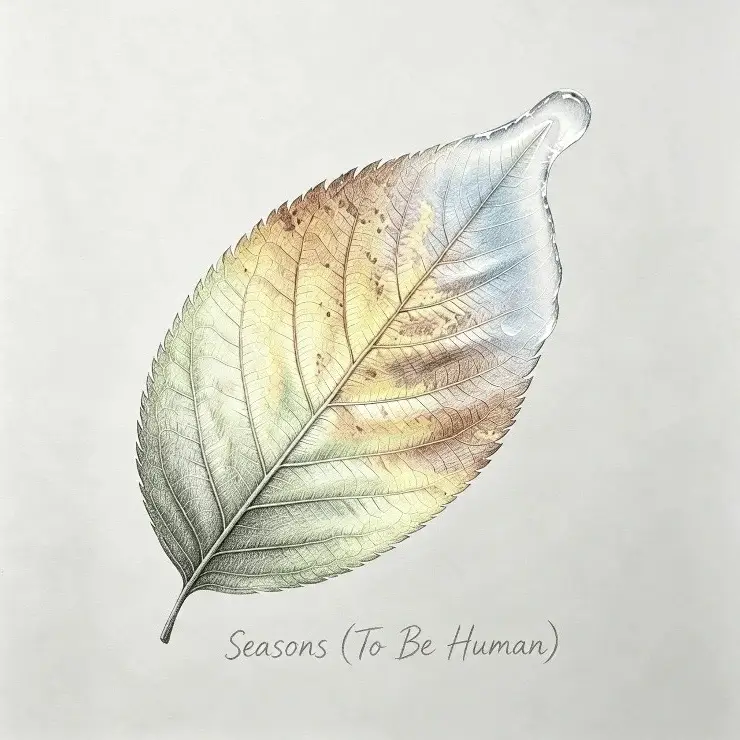
There are few things more dangerous in music than a song announcing that it is about the entire human experience. That is an enormous amount of emotional territory to cover in a few minutes, and it usually comes with an equally enormous guitar solo. Steven Luke’s Seasons (To Be Human) at least has the good sense to approach the subject through something considerably more familiar: the classic-rock ballad.
Luke, a Lancashire-based independent singer-songwriter, builds the track around the familiar language of classic rock and pop-rock, with warm vocals, piano, guitar, drums and a live cello performance doing most of the emotional heavy lifting. The result is atmospheric, earnest and unapologetically big.
The song opens with a blues-rock influence that immediately places it somewhere between the softer end of ’70s rock and the grander ballads that followed. There is a little Eric Clapton and Gary Moore in the musical DNA, particularly in the guitar work, which provides much of the song’s initial character. The piano gives it a steadier foundation, while the drums gradually push the arrangement forward.
And then there is the cello, which is arguably the song’s most interesting decision. In an age where you can produce approximately anything inside a laptop, bringing a live cello into a classic-rock arrangement feels almost suspiciously old-fashioned. Fortunately, it works. The instrument adds a cinematic quality without completely turning Seasons (To Be Human) into the soundtrack to a very expensive period drama.
The arrangement does, however, have a tendency to pile things on. As the song grows, the layers become increasingly dense, and some of the individual instruments can get buried beneath the overall sound. That is not necessarily a production failure. It feels more like Luke is chasing scale, allowing the song to become a wall of sound as its emotional stakes rise.
The song tracks this same trajectory. The seasonal images describe what it means to love and to lose, to be loyal and to feel disconnected from others, as well as those inconvenient moments in life when it can be tough to connect. The prevailing theme of emotional coldness provides the song with a singular allegory, which works best when left relatively subtle.
Beneath the orchestration and classic-rock vocabulary, Seasons (To Be Human) is built around a song that knows how to move. Luke’s voice fits the material without trying to turn every line into a vocal Olympics event, and the musicianship gives the track enough warmth to match its themes.
It is not reinventing the rock ballad, and it clearly does not intend to. Seasons (To Be Human) is interested in something much less fashionable: making a big, sincere song about being alive and trusting the old machinery to carry it. Surprisingly enough, the machinery still works.
Follow Steven Luke
About the Author

A tenured media critic known working as a ghost writer, freelance critic for various publications around the world, the former lead writer of review blogspace Atop The Treehouse and content creator for Manila Bulletin.