
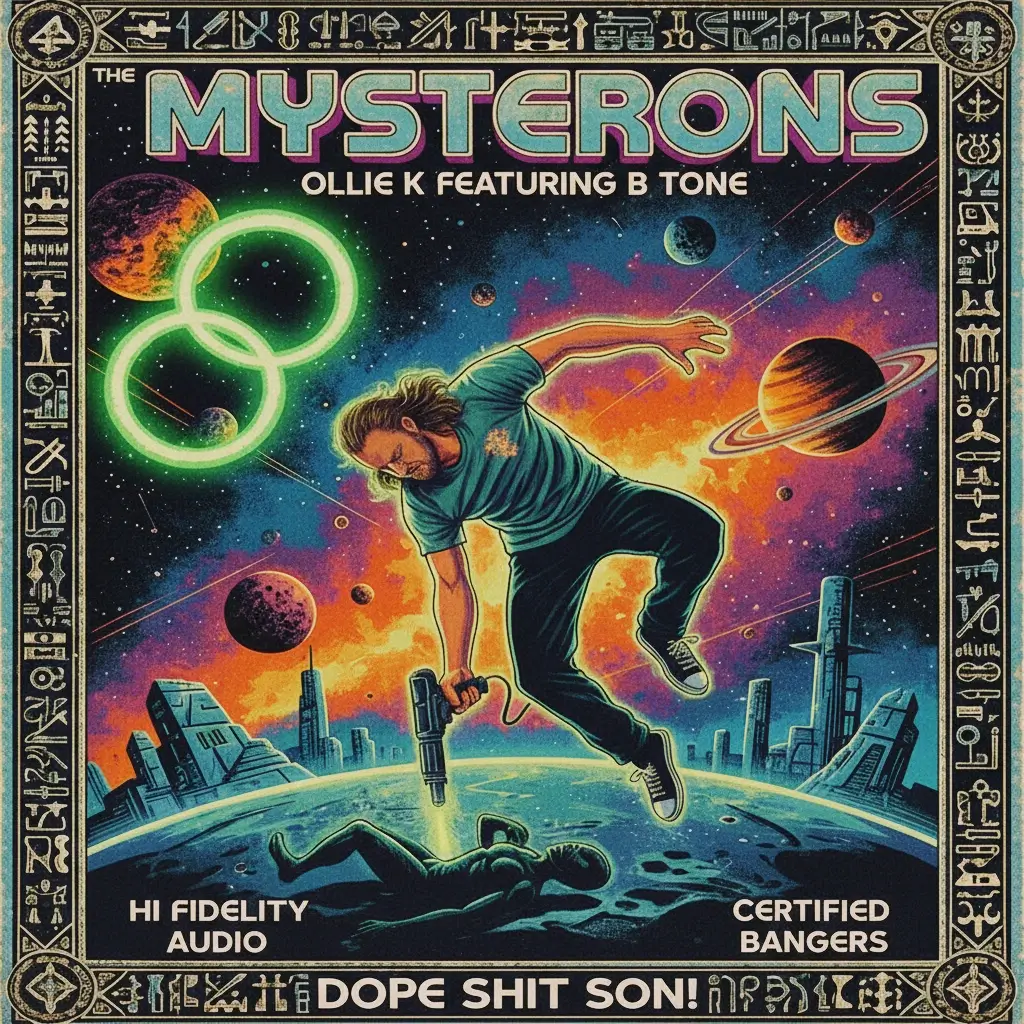
There’s something inherently ambitious about The Mysterons, the kind of album that could only be made by someone who’s spent years living inside both their record collection and their imagination. Devon-based artist Ollie K’s latest project isn’t just a record; it’s an experience, a transmission from a parallel universe where Captain Scarlet, MF DOOM, and DJ Premier share the same airwaves. It’s nostalgic, cinematic, and deeply personal, yet weirdly timeless in its execution. Scheduled for release on October 26, 2025, The Mysterons feels like the product of decades of quiet obsession;a lovingly constructed sound-world where 1960s sci-fi collides with 2000s underground hip-hop and British grit.
What makes The Mysterons compelling isn’t just its premise, but how fully Ollie K commits to it. This isn’t a gimmick album. Every skit, sample, and snatch of dialogue from Captain Scarlet is woven into the production like part of its DNA. Recorded, produced, and mixed entirely in Ollie’s home studio, the record bears all the hallmarks of a true DIY project: rough edges, warm analog textures, and an obsessive attention to atmosphere. It’s a project that rewards deep listening, the kind of album that sounds straightforward on first play and then keeps unfolding with every revisit.

The opening skit, The Mysteron Threat, sets the tone perfectly with a dispatch from another era, complete with vintage crackle and radio interference. What follows is Captain Scarlet, a track that immediately recalls the swagger of MF DOOM’s Madvillainy, but with a distinctly British sensibility. Ollie’s flow is clipped and sharp, his delivery more conversational than performative, and yet it fits the dusty beat like circuitry. It’s the sound of someone half-rapping, half-narrating their way through an alternate reality. The production is lush but unsettling, layers of brass and strings buried under tape hiss, giving it a haunted, archival feel.
Then there’s Humid in Here, a curveball that swaps noir tension for something almost danceable. Built around a hypnotic flute loop and a bassline that feels both playful and slyly menacing, it’s the kind of track that sneaks up on you. Ollie’s verses move between deadpan humor and sharp introspection, painting scenes that feel both mundane and cosmic. It’s a balancing act few pull off without collapsing into parody, but here it works; it’s oddly funky, like The Avalanches if they’d grown up on pirate radio instead of surf rock.
By the time Spectrum is Green rolls around, the album’s narrative logic begins to click. The snippets from Captain Scarlet aren’t just aesthetic; they form a loose storyline about control, paranoia, and the blurred line between man and machine. The production here leans heavily into collage territory: chopped vocal fragments, reversed guitar lines, snare hits that sound like they’re echoing through a submarine hull. It’s chaotic in the best way, recalling Frontier Psychiatrist by The Avalanches but with a darker, dustier twist.
Voice of the Mysterons might be the album’s crown jewel; a track that feels like DJ Premier and Skepta teamed up in a lab orbiting Mars. The beat is skeletal but potent: sharp drums, ghostly samples, and a low, creeping synth that sounds like a transmission from another dimension. Ollie’s voice sits right in the pocket, every syllable deliberate, every pause charged. There’s a confidence here that suggests an artist fully in command of his tools. It’s hip-hop that doesn’t try to mimic its heroes; it reimagines what they stood for.
Between these full-length tracks, Ollie threads in short skits like The Lunar Controller, which acts as both palette cleanser and world-building device. These moments prevent the album from ever feeling static; they’re like shortwave signals interrupting the broadcast, reminding you that you’re eavesdropping on something much stranger than a conventional record.
The presence of collaborator B-Tone-33 on hooks like The Imposter and In the Shadows adds an extra layer of texture, grounding Ollie’s dense production with soulful, rugged vocal lines. Their chemistry gives the project a communal feel. This isn’t just one man tinkering in isolation; it’s a collective vision built from late nights and shared frequencies.
What’s striking about The Mysterons is how confidently it straddles the line between concept and craft. It would be easy for an album this referential to collapse under its own cleverness, but Ollie K avoids that by making the story secondary to the sound. Every choice, every dusty sample, every clipped vocal is in service of mood and motion. It’s music that feels alive because it was made by hand, not by algorithm.
In many ways, The Mysterons plays like a thought experiment: what if Madvillainy had been made by a British producer raised on Gerry Anderson reruns and analog synths? But that comparison, while flattering, undersells the originality here. This isn’t mimicry; it’s reinvention. Ollie K has taken the ghosts of both the musical and televisual past and built something new from their remains.
By the end, The Mysterons doesn’t resolve so much as it fades out, like a transmission slipping out of range. It leaves you wanting to tune back in, to catch the next message. And maybe that’s the point. The Mysterons is a time capsule from the future. It’s weird, immersive, and quietly brilliant; the work of an artist who’s not just paying homage to his influences, but communing with them.
Follow Ollie K
About the Author

A tenured media critic known working as a ghost writer, freelance critic for various publications around the world, the former lead writer of review blogspace Atop The Treehouse and content creator for Manila Bulletin.