
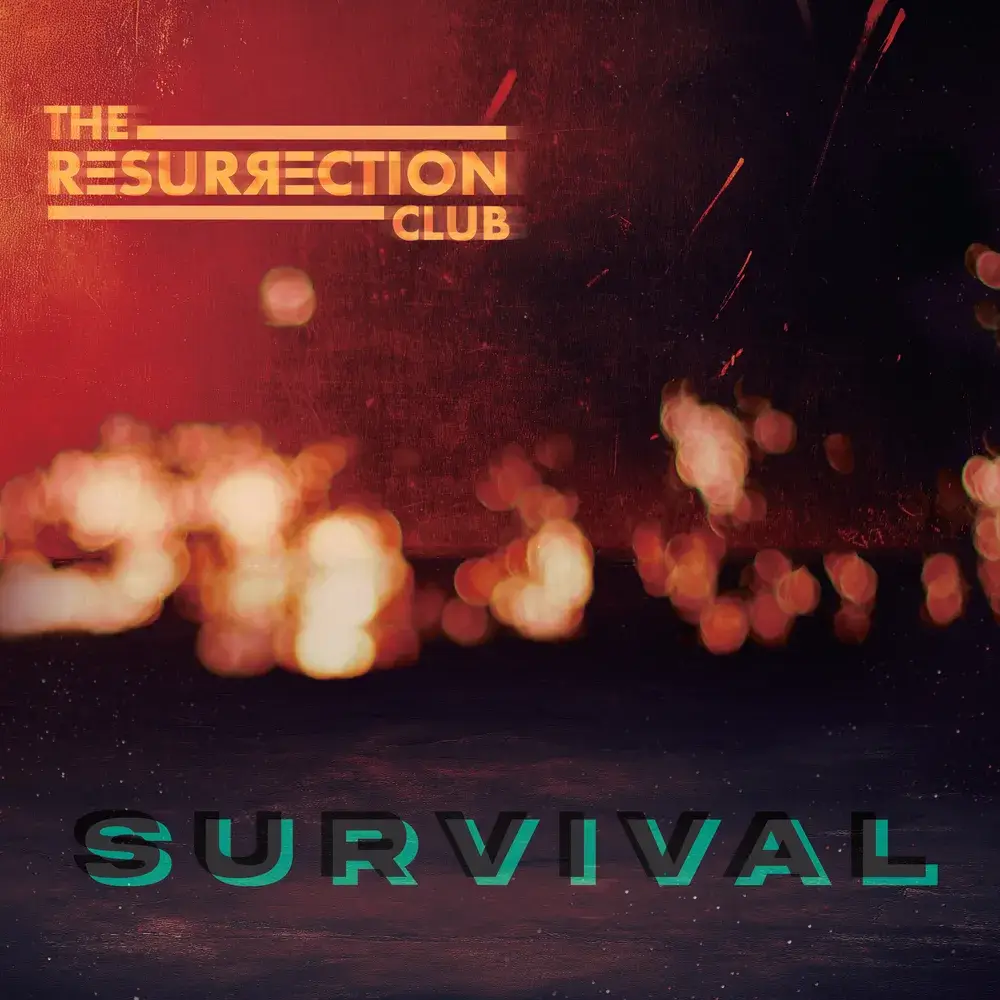
There’s something deeply dramatic about two former post-punk musicians from Glasgow reconnecting after decades apart and deciding, instead of quietly reminiscing about “the old days,” to make an album about surviving modern existence.
It’s either the beginning of a midlife crisis or the start of something genuinely moving and on Survival, the debut album from The Resurrection Club, it turns out to be the latter. The album was built remotely; songs exchanged in fragments across three continents like emotional care packages. There’s something poetic about that: an album about connection made through literal distance. It could have felt cold, overly digital, stitched together by convenience. Instead, it sounds stubbornly human.
Producer and DJ Robin Twelftree, known for work alongside The Prodigy, helps sculpt the record’s sound into something that balances atmosphere with urgency. Guitars chime and brood in that classic post-punk way: spacious, slightly haunted, occasionally brittle. But they’re threaded through ambient electronics that expand the sonic palette into something cinematic rather than nostalgic. This isn’t a heritage act reliving 1982. It’s two musicians acknowledging 2026.
Lyrically, Survival is not subtle about its concerns. War. Climate anxiety. Alienation. The general sensation that the world is on fire and everyone’s arguing about the thermostat. But the remarkable thing is that the album refuses to wallow.
Take “Emergency.” Its refrain of “we have no plan B” could easily tip into apocalyptic melodrama. Instead, it feels restrained, almost weary. The urgency simmers rather than explodes. The production pulses underneath, a low-level anxiety hum that mirrors the lyric without turning it into a slogan. “Every Second Counts” leans further into isolation. There’s a line about no one listening that lands with uncomfortable familiarity. The arrangement gives the vocal room to feel exposed, as if it’s echoing into a slightly too-large space. It’s the sonic equivalent of shouting into the algorithmic void and waiting for a human response.
“Survival Pt. 1” hits straight at the core of the album. “I’m not giving up” sounds cheesy on paper. Like a quote printed on a random coffee mug. But here, it works. The voice shakes a little. The guitars feel thick and heavy around it. Suddenly the line doesn’t feel fake. It feels earned. You can hear time in that voice. Not dramatic pain. More like someone who’s been through it and kept going. When “Survival Pt. 2” ends the record with “I’m still breathing,” it doesn’t feel like a big victory lap. It’s quieter than that. No grand speech or “everything’s fixed.” Just survival and being here. And right now, that’s enough.
What makes the album compelling isn’t just the thematic weight. It’s the emotional candour. McLeish has said some songs were difficult to even sing, that there were tears in the studio alongside laughter. You can hear that push and pull. The vocals occasionally fray at the edges, but they never collapse. It’s like vulnerability without self-pity. The album sits in an interesting space between analogue spirit and digital geography. Recorded in part at Sol de Sants Studios yet assembled through file-sharing and long-distance iteration, it feels both grounded and dispersed. The guitars retain that tactile, almost physical presence, while the electronics give the songs air and distance.
And importantly, perhaps even rebelliously with the current state of music production as of late, it’s entirely human-made. No algorithmic polish, no AI sheen. In an era where music increasingly feels optimized for playlists and passive consumption, Survival insists on sincerity. That alone feels mildly radical.
Survival is less about grand resurrection and more about quiet persistence. Two musicians reconnecting. Two voices finding harmony again. An album about global instability that still believes in small-scale connection in moments that contribute to the album’s overall mood: reflective, patient, unconcerned with chasing immediacy.
It’s music made apart, about closeness. A record that acknowledges the noise of the modern world but chooses to answer with empathy rather than despair.
Follow The Resurrection Club
About the Author

A tenured media critic known working as a ghost writer, freelance critic for various publications around the world, the former lead writer of review blogspace Atop The Treehouse and content creator for Manila Bulletin.