
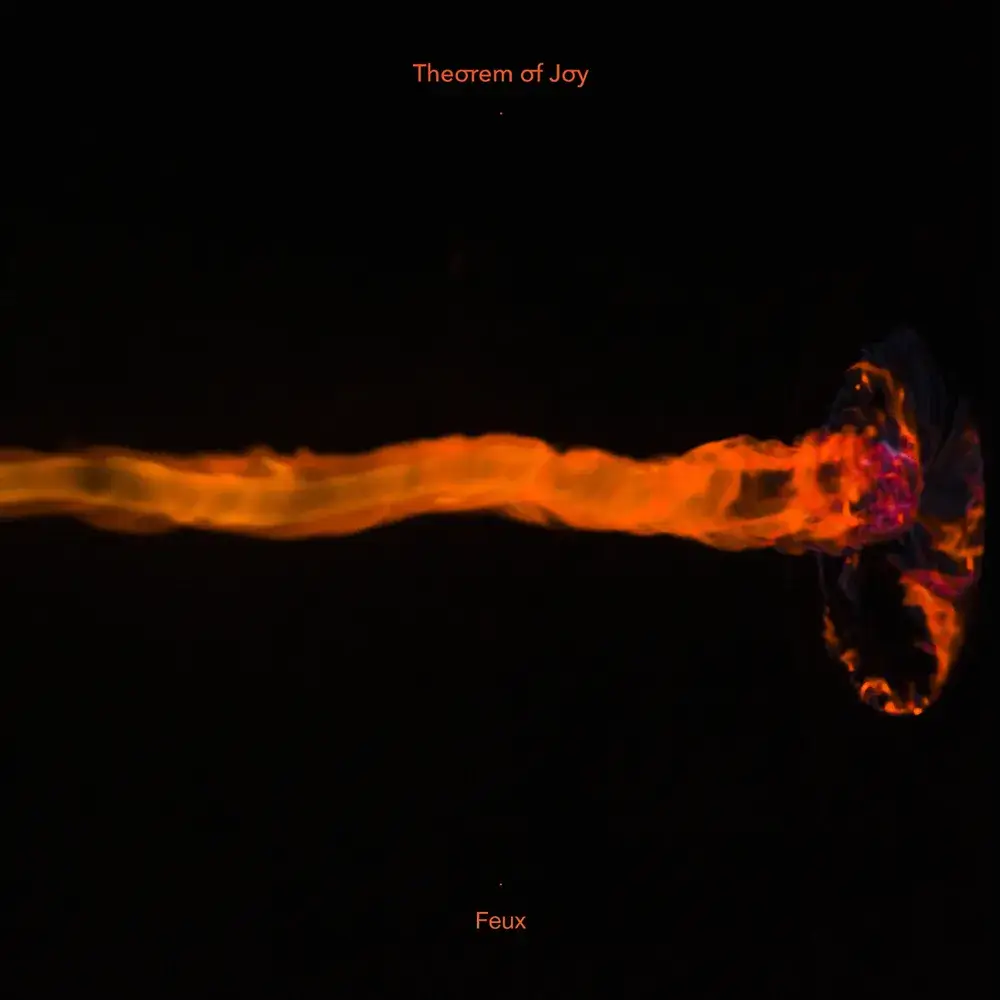
By the time a jazz group reaches its third album, there’s usually a choice to be made. You either double down on the sound that earned you attention in the first place, or you take the riskier route and ask questions your earlier work only hinted at. With Feux, Theorem of Joy chooses the latter and does so with the quiet confidence of a band that understands exactly who it is, even as it deliberately destabilizes that understanding.
Founded in 2017 by composer and double bassist Thomas Julienne, Theorem of Joy has spent the better part of a decade carving out a reputation as one of the more thoughtful formations on the contemporary jazz scene. Their self-titled debut in 2018 introduced a group deeply invested in texture and restraint. L’Hiver, their album from 2021 expanded that palette into colder, more introspective territory, while Dysnomia Live released the next year, a photo-concert collaboration with photographer Alexandre Dupeyron, blurred the boundaries between performance, documentation and memory. A major tour in China in autumn 2024 further cemented the group’s international presence, but Feux feels less like a victory lap and more like a reckoning.

The album’s title Feux, or Fires, isn’t metaphorical window dressing. Fire is the organizing principle here, treated not as spectacle but as paradox: destructive and regenerative, intimate and collective. Julienne frames the record as a question rather than a statement. Where do our inner fires come from? Which ones sustain us, and which ones burn us out? It’s a conceptual approach that could easily tip into abstraction, but Feux remains grounded through precise composition and an almost stubborn emotional clarity.
Across eleven tracks, the album unfolds as a kind of initiatory journey. “New Spring” opens the record with cautious optimism, not through grand gestures but through gradual unfolding. There’s a sense of emergence here; ideas forming, retreating, then reappearing with more conviction. “Au Monde” follows with a more outward gaze, its brevity suggesting a moment of contact with something larger before pulling back into reflection.
What’s striking about Feux is how often it resists the temptation to resolve itself. Pieces like “Heart Wide Open” and “Behind the Sky” feel emotionally expansive, yet they never overstate their intentions. The ensemble moves with remarkable cohesion, allowing space and silence to function as compositional tools rather than gaps to be filled. Jazz here is less about virtuosity on display and more about collective listening; about the notes you don’t play, as Abigail Thorne of PhilosophyTube would say.
The two “Echo” interludes are brief, almost fragile, but they act as hinge points within the album. They don’t exist to impress, but to recalibrate. In a genre that often equates complexity with density, these moments of restraint feel quietly radical. They remind the listener that reflection is an active process, not a passive one.
Midway through the record, “Little Raymonde” and “In the Way” bring a warmer, more human texture to the album’s conceptual framework. There’s a sense of memory here. Maybe personal, possibly familial, though the music never insists on a specific narrative. Instead, it gestures toward shared experience, inviting listeners to project their own histories into the space the band creates.
The latter half of Feux becomes increasingly outward-looking. “El Haik Dance Floor” introduces a rhythmic urgency that feels almost celebratory, while “Upside Down Candle” and “Ideal Robots” return to the album’s central question: how do we live together? These tracks grapple with modern anxieties of technology, alienation, collective responsibility, all without lapsing into didacticism. The music doesn’t offer solutions; it offers conditions for thought.
Throughout, Julienne’s compositional voice remains firm but generous. He doesn’t dominate the ensemble; he organizes it. Theorem of Joy functions less as a band with a leader and more as a system of interdependent parts, each responding to the others in real time. That dynamic gives Feux its emotional credibility. The doubts and hopes the album explores don’t feel theoretical. If anything, they feel lived in.
Ultimately, Feux succeeds because it understands jazz not as a genre to be defended, but as a language capable of asking urgent questions. This is music that engages with the present moment without trying to pin it down, acknowledging uncertainty as a fundamental condition rather than a problem to be solved.
Listening to Feux is to move through light and shadow, destruction and renewal, solitude and society. It’s an album that trusts its audience to listen carefully and rewards them when they do.
Follow Theorem of joy
About the Author

A tenured media critic known working as a ghost writer, freelance critic for various publications around the world, the former lead writer of review blogspace Atop The Treehouse and content creator for Manila Bulletin.